artificial intelligence
Creating artificial intelligence - a computer program that copies the human brain - needs knowledge and skills from many different areas of science. Let's see which ones.
Imagine a tall building - a laboratory, where scientists and engineers from different fields are working on creating a robot that can take care of pets.
The robot - like most robots - has a computer instead of a brain. That's why it still struggles with tasks that are very easy for us, like tying shoelaces. But even now, we can call some machines "intelligent," because they can:
- understand what we say to them ("order food for the cat named Filemon"),
- process that information ("I remember Filemon likes tuna"),
- solve problems ("the favorite pet store is closed, so I'll need to find another one online"),
- make decisions ("should I order tuna with salmon or with seafood?"),
- complete complex tasks ("add the product to the cart, finish the order, and make the payment").
Even building a simple robot that only orders pet food needs knowledge from many fields. Here are the kinds of scientists and engineers you need in an artificial intelligence lab.
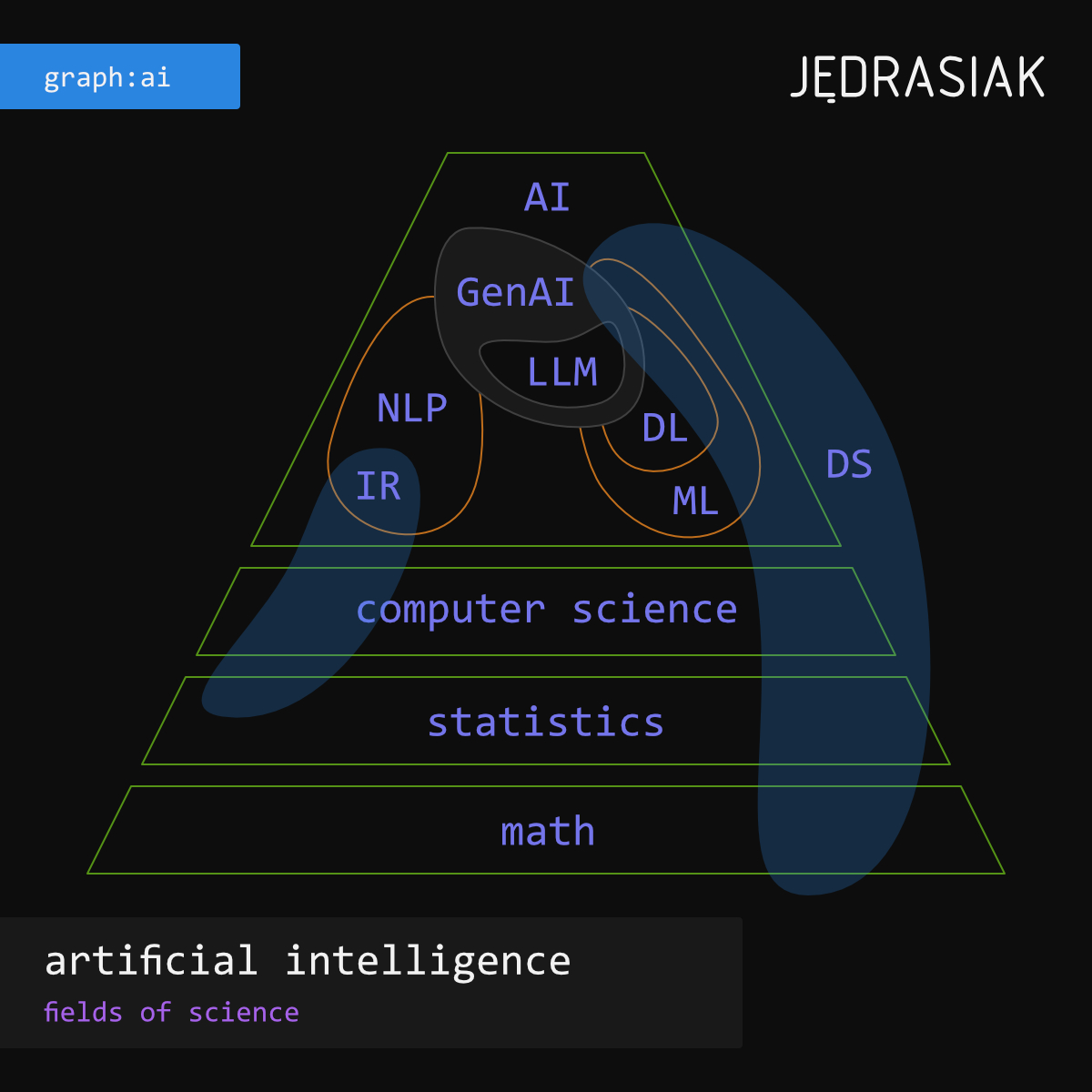
Top floor: "Generative artificial intelligence"
On the top floor, there is a sign saying Generative Artificial Intelligence (GenAI). Here, you'll meet specialists who help the robot talk to people like a human.
The robot's main job is to follow the owner's instructions. You can give commands in different ways: by speaking if you're near the robot or by sending a message when you are away. No matter how you talk to it, the robot first needs to understand what you mean. The people responsible for this are from the natural language processing (NLP) team.
It's also good if the robot can answer your questions, like "Did you change the rabbit's water today?" or "Did you order food for the dogs?" This is done by experts who work with large language models (LLMs) - very advanced programs that can create text that sounds like it was written by a human.
Floor: "Memory management"
Imagine having to remind the robot every time that Reksio the dog only eats from the green bowl, and Filemon the cat from the blue one. That wouldn't be helpful. The robot needs to remember things and use them at the right time - quickly and without mistakes.
This is the job of engineers who work in information retrieval (IR) and knowledge management. They make sure the robot doesn't mix up facts or get confused by having too much information.
Floor: "Learning"
The robot has to keep learning new things all the time. It should do this mostly on its own, by watching what happens around it.
When the robot comes to a new home, it needs to learn the family's habits - for example, when the owner takes the dogs for walks on weekdays and weekends (because everyone likes to sleep longer on weekends, even pets!). This skill is called pattern recognition, and it is the work of machine learning (ML) engineers.
They work closely with deep learning (DL) scientists. These experts show the robot thousands of pictures of pets so it can tell the difference between Reksio and Filemon (and not mix up their bowls).
On the same floor, down the hall, are data science (DS) specialists. They collect and store huge amounts of data, which the engineers use to teach the robot new things.
Ground floor: "Computer science"
When you tell the robot, "change the water in Nemo's fish tank," a very complex process starts in its artificial brain:
- record the command as a sound file,
- remove background noise,
- turn the voice into text,
- understand the command,
- check what it knows about Nemo and what is needed (it would be very bad if the robot poured boiling water from the kettle into the tank!),
- plan the next steps,
- do the task,
- prepare a reply ("I changed the water"),
- turn the reply into text or speech.
All of this has to be inside a computer program that is fast and works well. This job belongs to the programmers on the computer science floor.
Basement
In the basement of the artificial intelligence lab, you will find scientists who work on mathematics and statistics. They are not very visible and are often forgotten when awards are given out. People think they are strange. But the truth is, without their work, the other departments could not function.
Mathematicians created formulas that helped programmers build the artificial brain - neural networks - that help the robot learn. Thanks to statisticians, engineers know how many pictures of dogs are needed for the robot to learn how to tell different animals apart.
Summary
Artificial intelligence is a field of science that tries to build computer programs that can copy human thinking.
Artificial intelligence takes knowledge from many fields: old ones (like mathematics and statistics), modern ones that are already well-known (like computer science, machine learning, and information retrieval), and completely new ones (like deep learning and natural language processing).